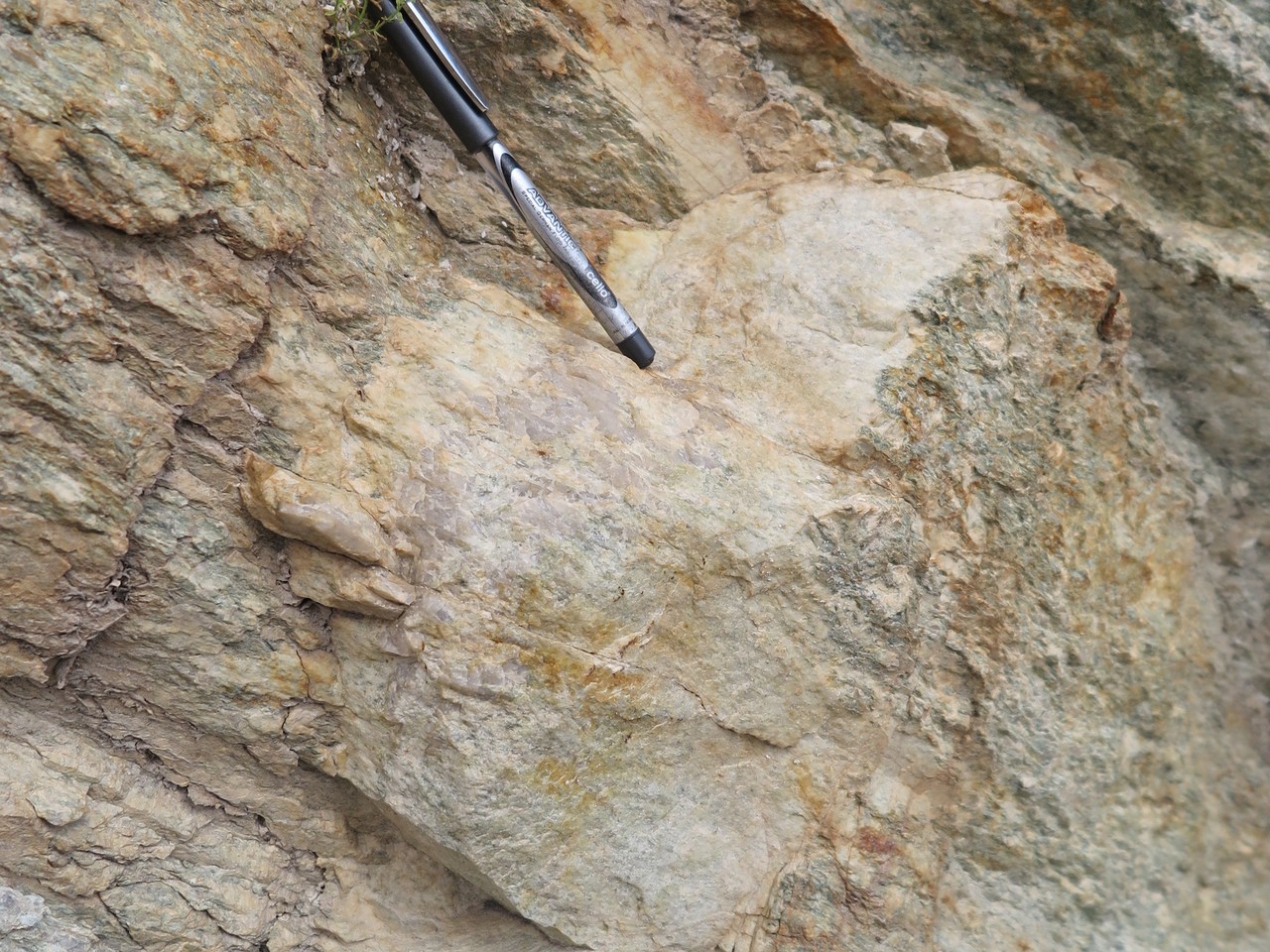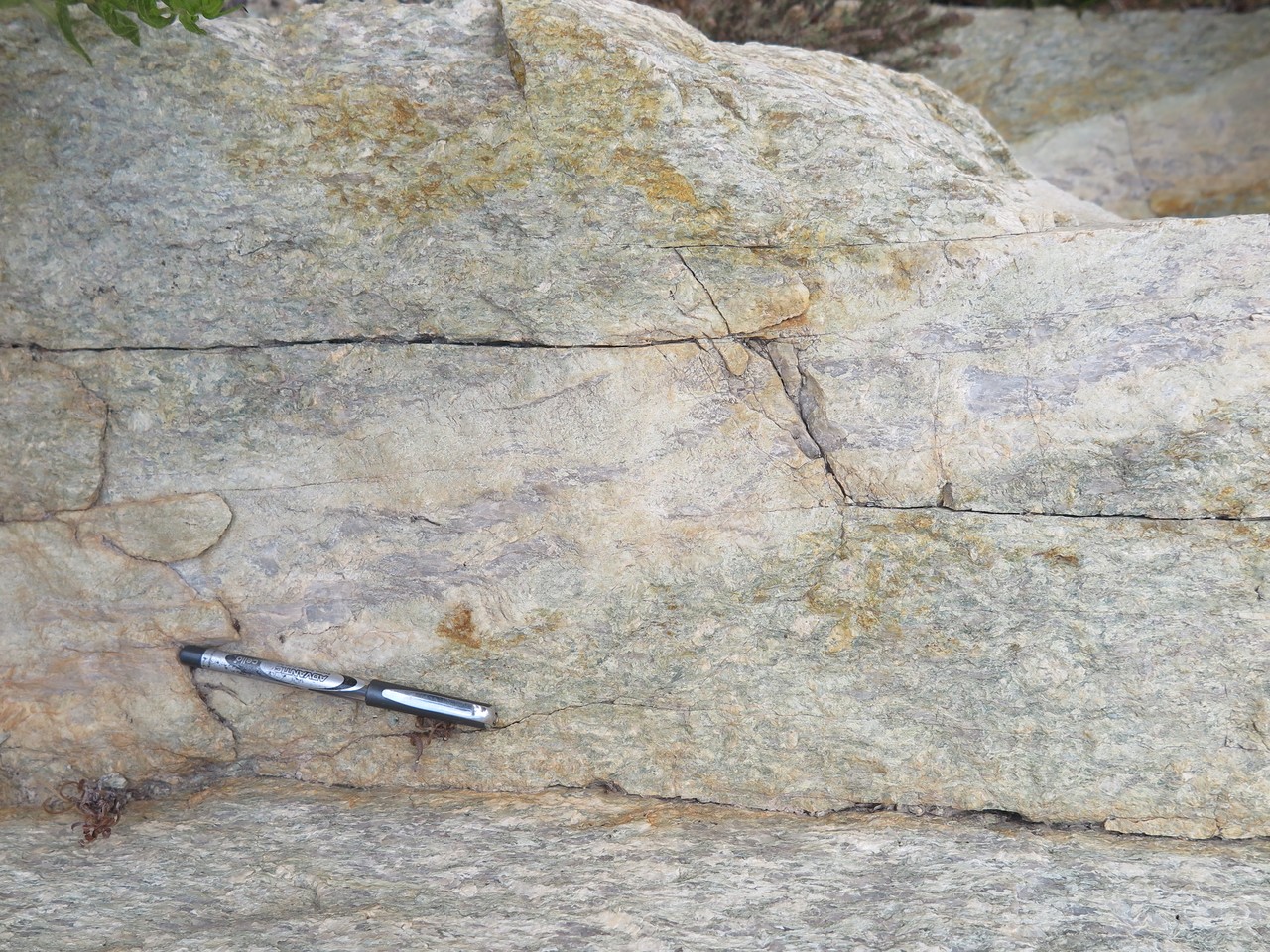
In this big roadcut ca. 1 km southwest of stop S2-2, we can see patches of weakly deformed metagranites that gradually transition to gneisses with well-developed schistosity. The schistosity is defined by quartz and feldspar layers. The stretching lineation is defined by elongated quartz and feldspar ribbons visible on the schistosity bands. Therefore, in this outcrop, the interconnected shear zones are even more visible than at location S2-2. On a regional scale main foliation wrapping around undeformed domains (meter to a kilometer in scale) and granitoids (but also in the intrusion of gabbros called the Bocca di Tenda) are crosscut by dykes of diabase (dolerite) and rhyolite both showing chilled margins against the host rocks (Malavieille, 2011).

Deformation and metamorphism of the Tenda Massif are well documented along the roadcut approximately 1 km SW from Fontana Morello Quarry. Here, it is possible to observe patches of weakly deformed metagranites that gradually transition to gneisses with well-developed schistosity. The schistosity is defined by quartz and feldspar layers. The stretching lineation is defined by elongated quartz and feldspar ribbons visible on the schistosity bands. Therefore, in this outcrop, the interconnected shear zones are even more visible than at location S2-2. On a regional scale main foliation wrapping around undeformed domains (meter to a kilometer in scale) and granitoids (but also in the intrusion of gabbros called the Bocca di Tenda) are crosscut by dykes of diabase (dolerite) and rhyolite both showing chilled margins against the host rocks (Malavieille, 2011).